How Much Drywall Do I Need? Sheet Count by Room Size
Lookup tables for 4x8 and 4x12 sheets, mud and tape totals, and the formula contractors use to estimate any room in seconds.
Last updated: 2026-05-17
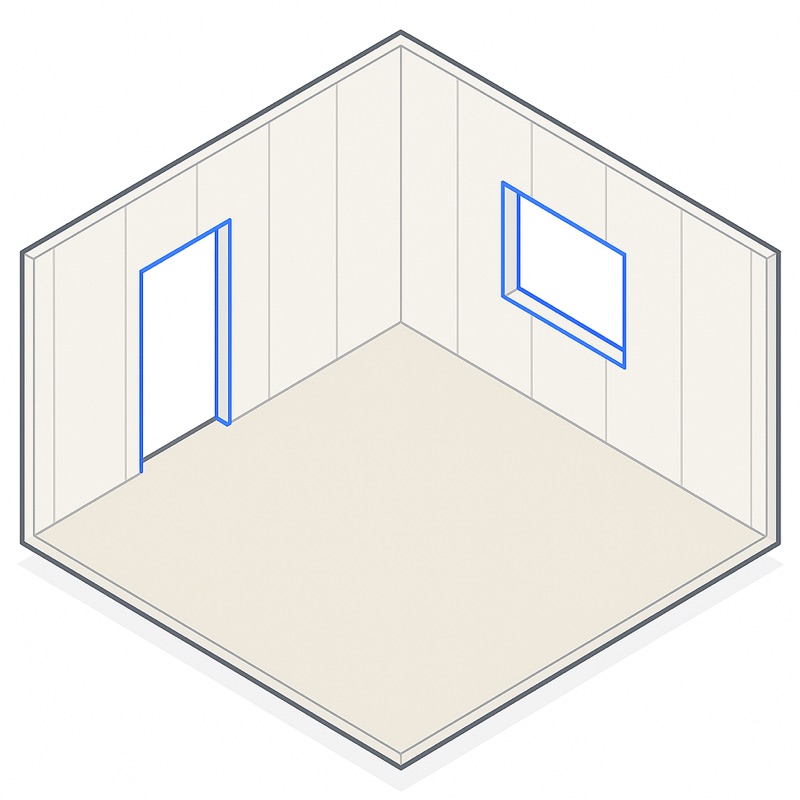
For a 12×12 room with 8-foot walls, you need 16 sheets of 4x8 drywall including 10% waste — or 8 sheets of 4x12 if you can get them up the stairs. That covers all four walls and the ceiling. Walls only (no ceiling) drops the count to 12 sheets of 4x8 or 6 sheets of 4x12.
The math is straightforward — total area divided by sheet area, plus a waste factor — but every room has wrinkles: door and window openings, sloped ceilings, partial walls in a basement, awkward closet bumps. This guide gives you a lookup table for common room sizes, the formula so you can estimate anything, and the supporting materials (mud, tape, screws) you need to actually finish the job.
Skip the math: use our drywall calculator to get exact sheet count with custom waste factor and opening subtractions for your room.
Quick lookup: sheets per common room
Assumes 8-ft walls, 10% waste, no opening subtractions. Round up to whole sheets at the store.
| Room Size | Walls Only (4x8) | Walls + Ceiling (4x8) | Walls + Ceiling (4x12) |
|---|---|---|---|
| 8 x 10 | 10 | 13 | 7 |
| 10 x 10 | 11 | 15 | 8 |
| 10 x 12 | 13 | 17 | 9 |
| 12 x 12 | 12 | 16 | 8 |
| 12 x 14 | 13 | 19 | 10 |
| 12 x 16 | 15 | 21 | 11 |
| 14 x 16 | 16 | 24 | 12 |
| 14 x 20 | 18 | 28 | 14 |
| 16 x 20 | 19 | 30 | 15 |
| 20 x 20 | 22 | 36 | 18 |
| 500 sq ft basement | 25 | 42 | 21 |
| 1000 sq ft basement | 45 | 80 | 40 |
Basement counts assume 8-ft walls on a square footprint with internal partition walls budgeted at the same rate. For finished basements with lots of interior walls, expect to add 15–25% on top of these numbers.
How to calculate drywall sheets
The formula:
sheets = (wall_area + ceiling_area − openings) / sheet_area × 1.10
Step-by-step for a 12×12 room with 8-foot walls, one 3×7 door and one 3×4 window:
- Wall area = perimeter × wall height = (12+12+12+12) × 8 = 48 × 8 = 384 sq ft
- Ceiling area = length × width = 12 × 12 = 144 sq ft
- Openings = (3 × 7) + (3 × 4) = 21 + 12 = 33 sq ft
- Net area = 384 + 144 − 33 = 495 sq ft
- Sheet area for 4x8 = 32 sq ft; for 4x12 = 48 sq ft
- Sheets (4x8) = 495 / 32 × 1.10 = 17.0 → buy 17 sheets
- Sheets (4x12) = 495 / 48 × 1.10 = 11.3 → buy 12 sheets
Some estimators skip the opening subtraction on the theory that the cutouts become waste anyway — that's a defensible choice for rooms with just one or two standard openings. For rooms with lots of glazing (sunrooms, walk-out basements) the openings are too big to ignore.
Walls only vs walls + ceiling
Walls only applies when you're patching, replacing damaged drywall, or doing a partial remodel where the ceiling stays. Common in flip houses where the previous ceiling is in good shape, or where the ceiling is already plaster or T&G boards you want to keep.
Walls + ceiling is standard for new construction, basement finishing, full gut remodels and any case where you want a uniform finish across all surfaces. The ceiling adds roughly the same area as one wall of the room, so the total sheet count jumps about 30–40%.
Hanging ceilings before walls is the contractor convention — drywall lifts make it manageable for one person, and the wall sheets then tuck up under the ceiling edge and hide the joint.
Sheet size choices (4x8, 4x10, 4x12)
- 4x8 (32 sq ft): The default. Weighs about 54 lbs in 1/2-inch standard, fits in any pickup and through any door, and one person can hang it solo. Downside: more seams to tape, so more finishing time.
- 4x10 (40 sq ft): Common in 10-ft ceiling rooms — lets you hang vertically with no horizontal seam at all. About 70 lbs per sheet, needs two people or a lift.
- 4x12 (48 sq ft): The contractor's favorite for long walls and ceilings. Fewer butt seams (the hardest seams to finish invisibly), faster overall, but 80+ lbs each and needs a truck or trailer to deliver. Skip this size if your stairs make delivery impossible.
Always check the 1/2-inch vs 5/8-inch thickness spec. Ceilings often require 5/8-inch (heavier, sag-resistant); walls are typically 1/2-inch. Wet areas (bathrooms) use moisture-resistant green board or cement board, not standard drywall.
How much mud, tape, and screws?
| Material | Per Sheet (4x8) | For 16-Sheet 12x12 Room |
|---|---|---|
| All-purpose joint compound | ~0.053 gal (1 gal per ~19 sheets) | 1 × 5-gal bucket (covers up to ~95 sheets) |
| Paper tape | ~5 lf | 80 lf — one 250-ft roll easily |
| Drywall screws (1-5/8 in) | ~32 (at 16 in OC) | 512 — buy 1 lb (≈400) plus a spare half-pound |
| Metal corner bead | Per outside corner only | 8 ft per outside corner |
Mud usage assumes a three-coat finish (tape coat, fill coat, skim coat). Heavier textures, more skim coats or repair work multiply the mud consumption. Screw count assumes framing at 16 inches on center; jump to ~40 per sheet for 12-inch OC commercial framing.
Waste factor: when to use 10% vs 15%+
- 10% — rectangular rooms, full sheets, minimal openings. A standard 12×12 bedroom with one door and one window falls into this bucket. Most cuts are straight and the offcuts are usable somewhere else.
- 15% — rooms with multiple openings, vaulted ceilings, or odd angles. Kitchens (lots of soffits and cabinet returns) and bathrooms (multiple openings in a small footprint) usually need 15%.
- 20%+ — extensive cuts, repairs, curved walls, or beginner installer. First-time DIY drywallers should bump to 20% — bad cuts and miscalculations are normal on the first project. Curved or vaulted ceilings can hit 25%.
Returning unused sheets is usually free if they're undamaged and you have the receipt. Cheaper to over-order than to make a second trip mid-project.
FAQ
Related calculators and guides
Ready to order? Use the drywall calculator for exact sheet count with custom waste factor and opening subtractions.