Rebar Calculator: Weight, Length & Bar Count
Use as a rebar estimator or basic takeoff calculator: bar count, total linear footage, total weight in lbs, and 20/40 ft sticks-to-order for concrete slabs, driveways, footings and walls.
Quick presets — click to load typical project values:
Stick counts assume individual 20-ft or 40-ft lengths sold at home centers; supplier mill-bundle quantities vary. For estimating only — verify against local code and your structural drawings.
📐 Fraction → decimal helper (tape measure conversions)
Type the decimal value into any input above. Example: 14-1/2 ft slab = 14.5 ; 6-3/4″ overlap = 6.75.
Anatomy of a Reinforced Slab (Cross-Section)
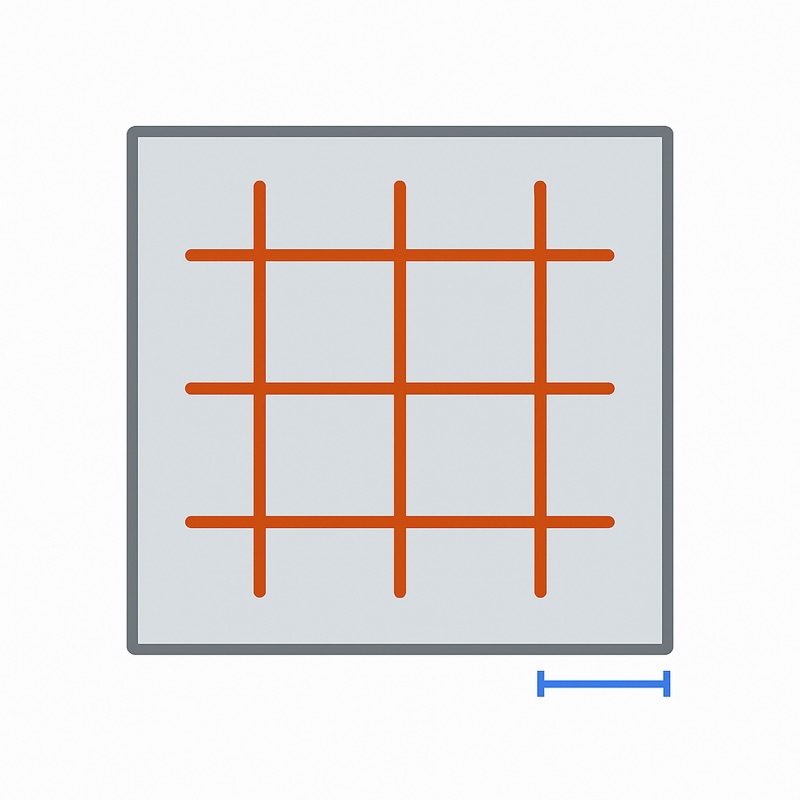
The live diagram above is a top-down view. This is the side view — showing where rebar sits inside the concrete, what holds it up, and how much cover protects it from rust.
Best Practices — Bar Size, Cover, Spacing, Lap
Four reference scales every rebar layout uses. Each comes from ACI 318 or industry standard practice.
Reinforcement Patterns by Element
Five common reinforcement layouts. Each shows the cross-section and the typical bar arrangement.
Installation Details — Chairs, Lap, Corner Hooks
Three details that determine whether your rebar actually works once concrete cures.
How the Rebar Calculator Works
This rebar calculator determines the number of steel reinforcing bars needed for a concrete slab by computing a two-direction (bidirectional) grid. Bars running parallel to the width are spaced across the slab length; bars running parallel to the length are spaced across the width. The bar count in each direction is the dimension in inches divided by the chosen spacing, rounded up to a whole number, plus one additional end bar. Every bar's length adds an overlap (splice) allowance — 6 inches is the standard residential minimum per ACI 318; commercial and structural work may require 12–24 inches. Total linear footage (all bars × their individual lengths) multiplied by the weight per linear foot gives you the total steel weight, which drives both cost and delivery logistics.
Standard Rebar Sizes — Quick Reference
| Bar Size | Diameter (in) | Cross-Section (in²) | Weight (lb/ft) | Common Use |
|---|---|---|---|---|
| #3 | 0.375 | 0.11 | 0.376 | Walkways, slabs-on-grade (light) |
| #4 | 0.500 | 0.20 | 0.668 | Residential driveways, patios, footings |
| #5 | 0.625 | 0.31 | 1.043 | Commercial slabs, retaining walls, columns |
| #6 | 0.750 | 0.44 | 1.502 | Heavy structural, bridge decks |
Recommended Rebar Spacing by Project
| Project Type | Bar Size | Spacing (in) | Slab Thickness |
|---|---|---|---|
| Residential patio | #3 or #4 | 18 | 4 in |
| Residential driveway | #4 | 12–18 | 4–6 in |
| Garage floor | #4 | 12 | 4–6 in |
| Pool deck | #4 | 12 | 4 in |
| Commercial floor slab | #5 | 12 | 6 in |
| Retaining wall | #5–#6 | 8–12 | 8–12 in |
Code & Best-Practice Notes
ACI 318 (the primary US concrete design code) requires a minimum concrete cover of 1.5 inches over rebar for interior slabs and 2 inches for slabs exposed to weather. Keep rebar at least 3 inches from the slab edge. For driveways and patios, position rebar in the middle third of the slab depth — not on the ground. Always use plastic bar chairs or dobies to hold rebar at the correct height before the pour.