Stair Calculator: Rise, Run, Slope & Stringer Length
Compute step count, rise per step, run per step, stringer length and stair slope (degrees) for interior, deck and basement stairs — with automatic IRC R311 code check and rise/run ratio (comfort + safety rules).
Quick presets — click to load typical floor-to-floor values:
For estimating only — verify rise, run, headroom and handrail against IRC R311 and your local building code before construction.
Live diagram
Updates as you change inputs. Geometry drawn to true angle.
Blue = your dimensions · Green = comfort/code pass · Red = IRC R311 violation · Sky-blue dashed = 6′8″ headroom envelope
📐 Fraction → decimal helper (tape measure conversions)
Type the decimal value into any input above. Example: 7-3/4″ riser = 7.75 ; 10-1/2″ tread = 10.5.
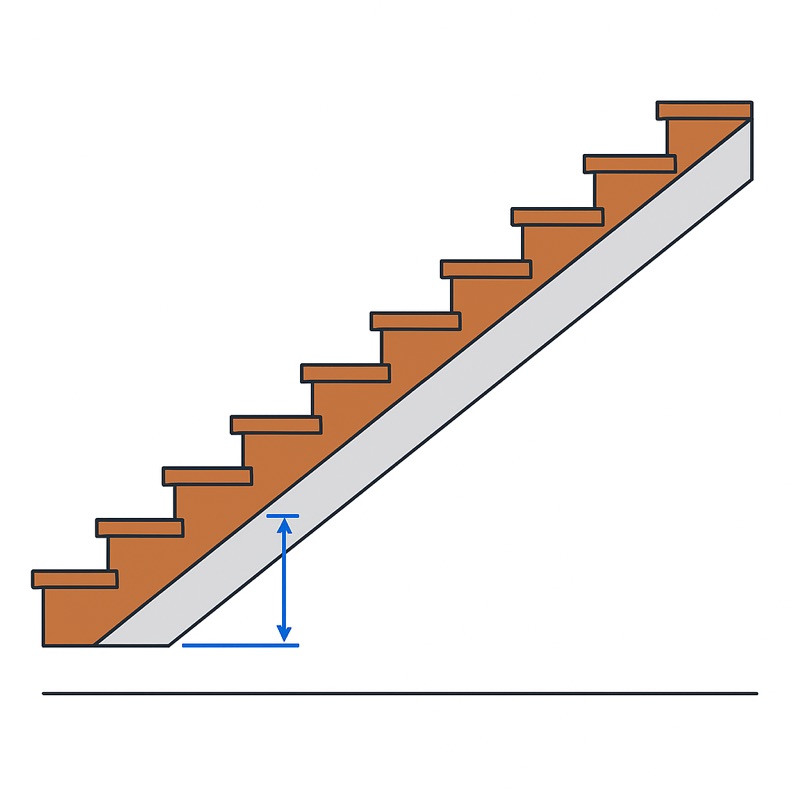
Anatomy of a Staircase
Every part has a specific name on construction drawings and in IRC R311. Each callout below uses the exact term you'll see in code and on architect's drawings.
IRC R311 Code Limits — Visualized
The red zones below show where your design cannot go without failing inspection. The green zones are the comfort sweet spot the calculator targets by default.
Stair Configurations — Pick the Right Layout
Five common residential layouts compared. Choose by available footprint and traffic flow, not aesthetics alone.
Mounting & Anchoring — Top and Bottom Details
The stringer can't just sit on the floor. Here's how it actually connects at each end. Switch the "Top mount" toggle above the live diagram to see each style applied to your dimensions.
How the Stair Calculator Works
This stair calculator uses your total rise — the vertical distance measured from finished floor to finished floor — and your preferred rise per step to compute the exact number of steps. It divides the total rise by the desired rise, rounds up to the nearest whole number of steps, then back-calculates the actual rise per step so every step is perfectly uniform (uneven steps are a leading cause of stair-related falls). The stringer length is calculated using the Pythagorean theorem: √(rise² + run²) per step, multiplied by the number of steps. The stair angle is the arctangent of rise over run, converted to degrees. An angle of 30°–35° is the comfortable "sweet spot" for interior residential stairs; deck stairs are typically steeper at 35°–40°.
How to Measure Total Rise Accurately
Total rise is the vertical distance from the top surface of the lower floor to the top surface of the upper floor (or landing). Measure with a level and tape measure — do not guess or use ceiling height alone. If you are building deck stairs, measure from the deck surface down to the ground at the base of the stairs (accounting for any planned landing pad thickness).
IRC Code Requirements — Residential Stairs
| Measurement | IRC Minimum/Maximum | Recommended Range |
|---|---|---|
| Rise (riser height) | Max 8.25 in | 7.0–7.75 in |
| Run (tread depth) | Min 9.0 in (nosing excl.) | 10–11 in |
| Tread nosing projection | 0.75–1.25 in | 1.0 in |
| Stair width (clear) | Min 36 in | 36–48 in |
| Headroom (vertical clearance) | Min 6 ft 8 in | 7 ft+ |
| Handrail height | 34–38 in above nosing | 36 in |
| Rise variation (flight) | Max 3/8 in between steps | < 1/8 in |
Common Stair Configurations by Application
| Application | Typical Rise (in) | Typical Run (in) | Angle |
|---|---|---|---|
| Interior residential | 7.0–7.75 | 10–11 | 32°–37° |
| Deck / exterior | 7.0–7.75 | 10–11 | 33°–38° |
| Basement utility | 7.5–8.25 | 9–10 | 37°–42° |
| Commercial / public | 4.0–7.0 | 11–14 | 16°–32° |
| Loft / ship ladder | 9.5–12 | 5–8 | 50°–68° |
Pro tip: Use the "comfort rule" to check your rise and run: rise + run should equal 17–18 inches for comfortable walking. A 7.5-inch rise with a 10-inch run sums to 17.5 — right in the zone. The "safety rule" states 2× rise + run should equal 24–25 inches; 2(7.5) + 10 = 25 ✓.