Stair Rise and Run Guide: Comfortable & Code-Compliant Stairs
IRC R311 limits, the comfortable rise/run range, and a layout chart for standard floor heights — plus the stringer formula with worked examples.
Last updated: 2026-05-17
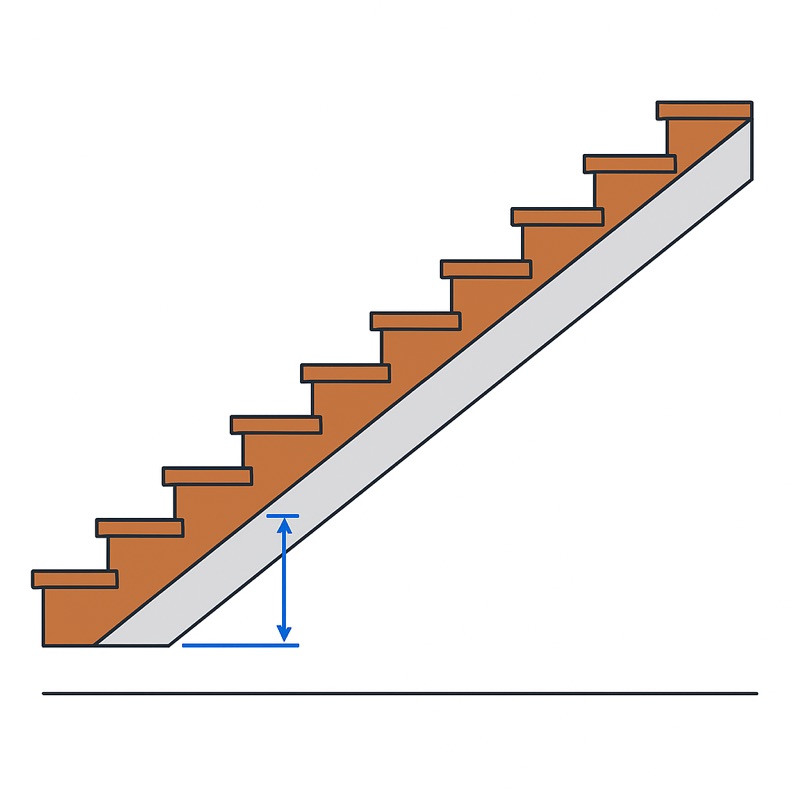
A comfortable stair has a riser between 7.0 and 7.75 inches and a tread between 10 and 11 inches. The IRC R311 maximum is an 8.25-inch riser with a 9-inch minimum tread depth and a 36-inch minimum clear width above the handrail. Stay inside the comfortable range whenever you have the run length to do it — code is a ceiling, not a target.
Most residential stair problems come from one of three sources: trying to fit too many risers into too little run, mixing inconsistent riser heights between flights, or forgetting that the floor assembly thickness adds 11–13 inches to the floor-to-floor measurement. This guide walks through the numbers, the code, and a layout table for the four floor heights you'll actually encounter.
Skip the math: use our stair calculator to get rise, run, stringer length and an IRC code check from your floor-to-floor height.
Quick answer: ideal rise and run
The comfortable target: 7.0–7.75-inch riser, 10–11-inch tread. The well-known rule of thumb is that rise + run should sit between 17 and 18 inches — a 7.5-inch riser with a 10.5-inch tread is exactly 18 and feels natural to climb. Steeper stairs are tiring on the way up and unsafe on the way down; shallower stairs eat too much floor space.
IRC R311 stair code summary
| Rule | Value |
|---|---|
| Max riser height | 8.25 in (7.75 in for newer IRC editions) |
| Min tread depth | 9 in (10 in preferred) |
| Min clear width above handrail | 36 in |
| Max riser-to-riser variance | 3/8 in within any flight |
| Min headroom | 6 ft 8 in (80 in) measured plumb above tread nosing |
| Handrail required | Any flight with 4 or more risers |
| Handrail height | 34–38 in measured vertically from nosing |
| Nosing projection | 3/4 to 1-1/4 in (when tread is less than 11 in) |
Local amendments override the model IRC — check your jurisdiction before pulling a permit. California, New York and most major cities have small variations.
How to measure total rise (floor to floor)
Total rise is the vertical distance from the finished surface of the lower floor to the finished surface of the upper floor. Three practical steps:
- Measure from finished floor to finished floor. Account for any flooring that will be installed later — 3/4-inch hardwood, 1/2-inch tile + thinset, carpet + pad each add real height that changes the riser math.
- Add the floor assembly thickness for upper floors. An 8-foot ceiling rough framing with 2x10 joists, 3/4-inch subfloor, finished floor on top means roughly 96 in (ceiling) + 9.25 in (joist) + 0.75 in (subfloor) + 0.75 in (finished) = about 107 inches floor-to-floor.
- Use a story pole or laser level for verification. Don't trust one tape measurement — measure at both ends of where the stair will land and use the average. Floors are rarely perfectly level.
Common stair layouts
| Floor Height (in) | Recommended Risers | Riser Height Each | Notes |
|---|---|---|---|
| 96 in (8-ft ceiling + 2x10 floor) | 13 | 7.38 in | Classic residential — comfortable |
| 108 in (9-ft ceiling) | 15 | 7.20 in | Modern build standard |
| 117 in (9-ft ceiling + thick floor) | 16 | 7.31 in | 9-ft ceiling with deep engineered I-joists |
| 120 in (10-ft ceiling) | 16 | 7.50 in | Custom/luxury build — needs more run |
Always divide the total rise by your trial riser count and check the result against the IRC max (8.25 in) and the comfortable range (7.0–7.75 in). If the riser comes out too tall, add one riser and recalculate. Remember: number of risers = number of treads + 1, because the top floor itself is the final tread.
Stringer length formula
A stringer is the diagonal board that supports the treads and risers. Its length follows the Pythagorean theorem:
stringer = √(total rise² + total run²)
Worked example for a 108-inch floor with 15 risers:
- Riser height = 108 / 15 = 7.20 in (within the comfortable range — good)
- Number of treads = 15 − 1 = 14
- Tread depth = 10.5 in (a comfortable choice)
- Total run = 14 × 10.5 = 147 in
- Stringer = √(108² + 147²) = √(11,664 + 21,609) = √33,273 = 182.4 in (about 15 ft 2-1/2 in)
Order stringer stock at least 6 inches longer than the calculated length to allow for end cuts and the bottom-floor nosing-down cut. Most stairs are built from 2x12 stringers; for spans over 13.5 feet, double them up or add an intermediate support.
Common stair mistakes
- Inconsistent riser heights. The bottom or top riser ends up taller than the rest because the installer forgot to subtract the tread thickness from the first cut. IRC allows only 3/8 inch of variance — anything beyond that is a tripping hazard and a code failure.
- No handrail on a 4+ riser flight. Any flight with 4 or more risers needs a graspable handrail on at least one side, 34–38 inches above the tread nosings. The handrail must return into the wall or a post at each end.
- Undersized tread depth. Treads under 10 inches force the user to land on the nosing instead of the tread surface — uncomfortable going up, dangerous coming down. The IRC 9-inch minimum is the absolute floor, not a goal.
- Missing or undersized nosing. When the tread depth is under 11 inches, a 3/4 to 1-1/4 inch projecting nosing is required so the effective foot-landing area meets minimums. Skipping the nosing on a 9-inch tread is a code violation.
- Ignoring headroom. The 6-foot-8-inch headroom is measured plumb from the front edge of each tread nosing up to anything above (ceiling, beam, wall). Stairs squeezed into renovations frequently fail this on the upper landing.
FAQ
Related calculators and guides
Ready to lay it out? Use the stair calculator to get rise, run, stringer length and a code check for your exact floor height.