Rebar Spacing Guide: How Far Apart Should Rebar Be?
A practical reference for residential, commercial and structural slab reinforcement — with a spacing chart, ACI 318 notes, and the most common mistakes.
Last updated: 2026-05-17
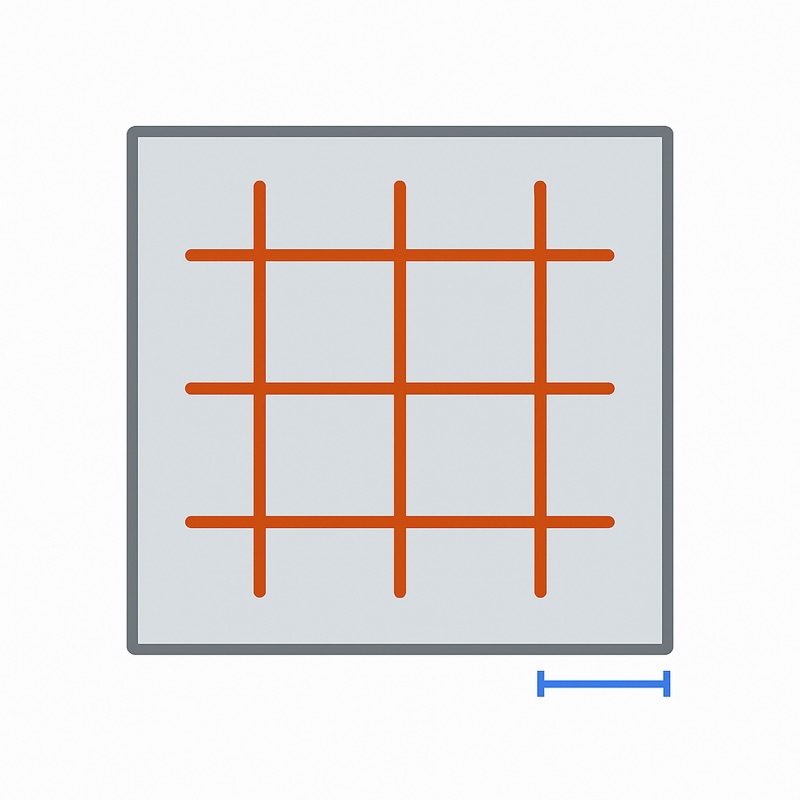
For residential slabs, 12–18 inches on center using #4 rebar is the standard. Drop to 12 inches for driveways, garage floors and any slab that takes vehicle traffic; 18 inches is fine for patios, walkways and lightly loaded pads. Heavy structural work — retaining walls, footings under load-bearing columns, commercial floors — tightens to 8–12 inches with #5 or #6 bar.
This guide is for DIY homeowners pouring their own slab, contractors double-checking a spec before ordering, and anyone who has been told "12 on center" and wants to understand why. We cover the spacing chart, what drives the number up or down, code-driven minimums, and the four mistakes that cause cracked slabs even when the rebar count is right.
Skip the math: use our rebar calculator to get exact bar count, linear footage and total weight for your slab in seconds.
Quick answer: standard rebar spacing by project type
| Project Type | Bar Size | Spacing (in) | Slab Thickness |
|---|---|---|---|
| Sidewalk | #3 | 18 | 4 in |
| Residential patio | #3 or #4 | 18 | 4 in |
| Residential driveway | #4 | 12–18 | 4–6 in |
| Garage floor | #4 | 12 | 4–6 in |
| Basement floor | #3 or #4 | 18 | 4 in |
| Pool deck | #4 | 12 | 4 in |
| Swimming pool deck (heavy) | #4 | 10–12 | 4–6 in |
| Commercial floor slab | #5 | 12 | 6 in |
| Retaining wall | #5–#6 | 8–12 | 8–12 in |
| Bridge approach slab | #5–#6 | 8–10 | 8–10 in |
All spacing is on center (OC) — measured from the center of one bar to the center of the next. Bars run in two directions to form a grid; the same spacing typically applies in both directions for slabs.
What determines rebar spacing?
Four variables drive the answer:
- Slab thickness. Thicker slabs distribute load better, so spacing can open up. A 4-inch patio at 18 inches OC is roughly equivalent to a 6-inch commercial slab at 12 inches OC.
- Expected loads. Static foot traffic is easy on concrete; cars, trucks and forklifts demand tighter spacing. Anything that rolls puts a concentrated point load on a small contact patch.
- Soil conditions. Stable, well-compacted gravel base allows wider spacing. Clay, fill or anything that moves seasonally needs tighter spacing to bridge the soft spots.
- Freeze-thaw exposure. Exterior slabs in cold climates expand and contract every winter. Tighter rebar grids hold cracks closed instead of letting them open up.
Why 12 inches is the residential default
12 inches on center is the workhorse spec for residential concrete because it hits the sweet spot between three constraints: enough steel to control cracking and handle vehicle loads, low enough cost that homeowners and small contractors will actually order it, and a spacing that matches readily available 20-foot stock bars without awkward cuts on a 20×20 slab.
At 12-inch spacing in a 20×20 slab, you get 21 bars in each direction (using the n = dimension/spacing + 1 rule) — 42 bars total of #4 rebar. That is roughly 840 linear feet, about 560 lbs, and a material cost in the $400–$600 range at typical 2026 prices. Going to 8-inch spacing nearly doubles the bar count and cost without proportional benefit for a residential pour.
When to go tighter than 12 inches
Drop to 8–10 inches OC when you have:
- Heavy vehicle loads. Loaded RVs, dump trucks, commercial trailers parked regularly.
- Retaining walls. Lateral earth pressure is high and concentrated; #5 at 8–12 inches OC is standard for walls over 4 feet tall.
- Structural slabs. Elevated slabs, slabs that span between footings, slabs supporting load-bearing walls. Engineering will spec this — don't guess.
- Poor soil. If you can push a rebar into the subgrade by hand, you need more steel, not just more concrete.
- Industrial floors with rack loads. Pallet racking puts concentrated point loads from the legs. Spec from the rack manufacturer's load tables.
When 18 inches is enough
Open up to 18 inches OC when load and exposure are both modest:
- Patios and walkways. Foot traffic only, no vehicles. #4 at 18 inches is plenty.
- Light residential floors. Basements, shed floors, small porches.
- Sidewalks. Many municipalities allow 6×6 wire mesh instead of rebar for residential sidewalks; rebar at 18 inches OC is a step up.
- Interior slabs over stable base. If the subgrade is compacted gravel over native soil that doesn't move, 18 inches works.
Below 18 inches you stop getting structural benefit per dollar — the spacing gets wide enough that early-life shrinkage cracks may not be bridged by a bar.
Common rebar spacing mistakes
- Bars too close to the edge. ACI 318 requires 1.5 inches minimum cover (2 inches for weather-exposed slabs) and you should keep bars 3 inches from any slab edge. Rebar within 1 inch of the edge will rust, swell, and pop the concrete edge within a few freeze-thaw cycles.
- Inconsistent spacing. Eyeballing it or skipping bars in one corner creates weak zones. Snap chalk lines or use a rebar mat with a known grid spacing.
- Wrong bar size. Using #3 where the spec calls for #4 reduces the steel cross-section by 45%. The grid pattern looks right but the slab cracks under load.
- No overlap (splice) at joints. Where two bars meet end-to-end, they must overlap. Minimum 6 inches for residential; 12+ inches for structural. Bars that simply touch end-to-end transfer no load across the joint.
- Rebar on the ground. Place rebar in the middle third of the slab depth using chairs or dobies. Bars sitting on the gravel base do nothing — concrete is strong in compression at the bottom; rebar belongs where the slab is in tension.
Spacing for two-way reinforcement vs one-way
Two-way reinforcement means the rebar grid runs in both directions — what we've been describing for slabs. Spacing is normally the same in both directions because the slab can crack in either direction.
One-way reinforcement is used in beams, lintels and narrow strip footings where load travels in a single direction. The "primary" bars run with the load (e.g., along a beam) at tight spacing; "shrinkage and temperature" bars run perpendicular at wider spacing — typically 18 inches OC or per code minimum. If you're pouring anything other than a beam or strip footing, plan on two-way.
FAQ
Related calculators and guides
Ready to order? Use the rebar calculator to get bar count, total linear footage and weight for your exact slab dimensions.